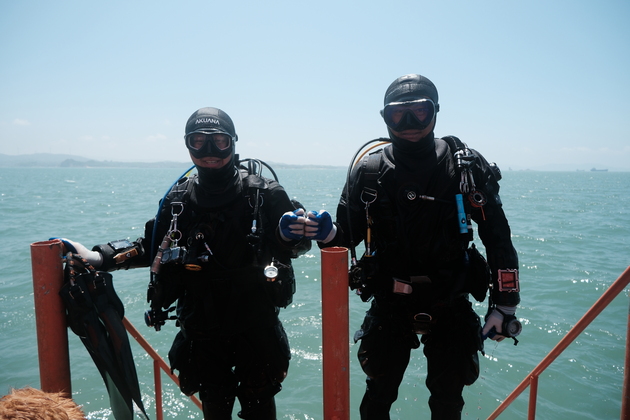
FUZHOU, Feb. 4 (Xinhua) -- Wearing thick and heavy diving gear, with a humming in his ears, Chen Hao follows a rope into deepening blue. His descent is slow and deliberate in water shrouded by silt clouds and diminishing visibility.
Eventually Chen's hand meets wood, the plank of a ship untouched for centuries. Above him lies the open sea and in front of him a concrete vision of history.
For nearly two decades, Chen has been making such descents into the depths of the sea. Now in his early fifties, he is deputy head of the underwater archaeology center at the Fujian provincial research institute of archaeology in east China, and is one of the few Chinese archaeologists who still spends much of the year underwater.
From China's northern seas to its southernmost waters, Chen's dives follow routes once traveled by merchant ships along the ancient Maritime Silk Road.
Chen, notably, looks like someone shaped as much by the ocean as by scholarship, being broad-shouldered with skin darkened by a combination of sun and salt. During the chill of winter, when hazardous seas temporarily halt diving, Chen turns his attention to the shore, compiling survey data and gearing up for future dives, among them a joint underwater archaeology effort in South Africa. Though sidelined from diving for now, the ocean still anchors his every endeavor.
"I prefer being at sea to sitting in an office," Chen said. "That's where the historical secrets are."
Before the sea became his workplace, Chen had a desk. In 2005, he held a stable office position at the Fujian Museum, and during this time he was sent to observe the excavation of the Wanjiao No.1 shipwreck, a Chinese merchant vessel dating back to the Qing Dynasty (1644-1911) that sank off the coast near Fujian's Pingtan County.
"Each day, divers raised hundreds of porcelain pieces from the seabed," he recalled. "The vessel carried tens of thousands of blue-and-white ceramics, preserved so exceptionally that the finds stunned everyone on site." Soon after, Chen left his desk job and applied to enter the field of underwater archaeology.
This transition demanded both physical endurance and resolve. In 2009, at age 35, just within the age limit, Chen joined the fifth national underwater archaeology training program, becoming its oldest participant and class monitor. Over three months, trainees were required to earn more than a dozen professional diving certifications before moving directly into fieldwork at submerged sites.
"You'd collapse into sleep the instant you touched the bed," Chen recalled. "But the anticipation of handling those relics on the seabed kept you going."
Of his cohort from those intense early days, fewer than five remain on the frontlines today.
Risk has always been part of the work. Diving off Wenzhou, east China's Zhejiang Province, Chen once operated in almost total darkness underwater, visibility so poor he could not read his wrist computer or compass. He moved by touch and instinct alone, relying on experience to read what he could not see.
Off Fujian's Shengbeiyu islet, meanwhile, the search was dominated by relentless tidal currents that repeatedly dragged him away from the target coordinates. Fighting the water left his legs numb. Back on deck, he would lie still for over an hour before recovering. It was through these punishing dives that the team finally fixed the exact position of a shipwreck dating back to the Yuan Dynasty (1271-1368).
Nothing has challenged Chen more consistently than the waters off Pingtan. Winds of force six or higher lash the area more than 300 days a year. Reefs cluster densely, currents tangle and shift, and survey vessels strike hidden rocks that crack their hulls. Yet, historically it was a major maritime corridor in China. For about a millennium, ships streamed through these waters, with many foundering there, leaving one of the nation's densest underwater archaeological fields.
The search for wrecks frequently begins with fishermen. Chen lingers for long stretches along the coast, listening. "Fishermen know the sea better than anyone," he said. "When they say something unusual lies below, it can be the breakthrough."
Time is not the only adversary. Looters can devastate a site and erase centuries of accumulated evidence in days. For Chen, protection precedes excavation. His institute collaborates with the coast guard, police and fisheries authorities, installing 24-hour monitoring in priority waters and carrying out regular patrols.
Chen has watched the field evolve through technology. Previously, equipment was mostly cumbersome and rough, heightening every risk and leading to inefficiency underwater. Today, real-time navigation and communication systems keep divers linked and oriented, while sonar, imaging and sensing tools locate wrecks with sharp accuracy.
Still, the act of recovery calls for profound restraint. Ropes, bamboo packaging fragments and hull filling materials can crumble at a touch after centuries underwater. His team uses adapted pneumatic tools to brush away sediment with care and encases delicate pieces in epoxy resin before lifting them to the surface.
Some discoveries have defined the arc of Chen's career. In recent years, especially, sites he helped uncover and excavate in China have delivered some of the field's most significant breakthroughs, ranging from the first physical proof of long-lost navigational tools surviving underwater, to the best-preserved mid-Ming Dynasty (1368-1644) merchant ship yet found in coastal waters and a vessel from the Yuan Dynasty that yielded an exceptional single-site collection of Longquan celadon and secured major national recognition.
The sea has taken its toll at home. Extended work assignments have left most family responsibilities to Chen's wife, and he has missed birthdays and been absent during periods of illness in the family. "My family's full understanding and support is what keeps me going," he said.
These days Chen splits his efforts between leading dives and mentoring the next cohort of divers, often serving as an instructor in national training programs. Underwater archaeology in China is still a narrow field, with just dozens of active frontline specialists across the country. "Fujian's exceptionally rich submerged heritage will rely on the successors now coming up behind me," he said.
Chen has no intention of retiring. "Every dive is a conversation with history," he said. "Every excavation writes a page for civilization." As long as his strength holds, he will continue descending, seeking to play his role in elevating what has lain in darkness for centuries to the surface.



 Share
Share
 Tweet
Tweet
 Share
Share
 Flip
Flip
 Email
Email